1948 — 1971
The car that put Britain on wheels
It was designed in secret during a war, nearly cancelled, widened by four inches at the last minute, and went on to outsell every British car that had come before it.
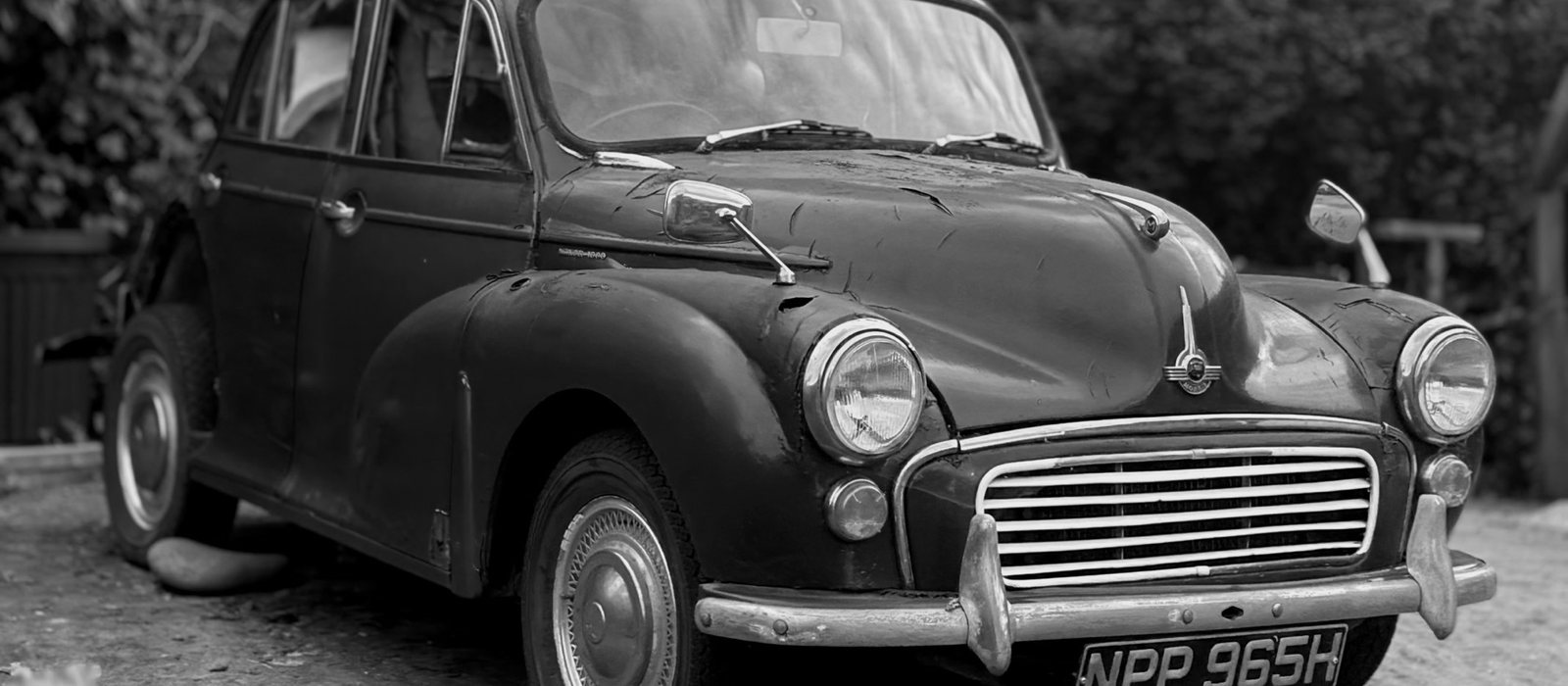
A car designed under blackout
In 1942, with Britain at war and Morris Motors building military vehicles, a young suspension engineer named Alec Issigonis began work on something the company was not supposed to be thinking about: a new small car for the peace that had not yet arrived. The project was codenamed Mosquito, after the warplane.
Issigonis — born in Smyrna, now İzmir, and brought to London as a refugee in 1922 — had joined Morris in the 1930s. He worked on the Mosquito with the draughtsman Jack Daniels, whom he called "the best all-round draughtsman in the country," and the two of them would go on to design the Mini together.
His brief was his own: a car with the road manners and comfort of something expensive, at a price a working family could pay. Nobody had really tried that in Britain. Small cars were small because they were cheap, and they drove like it.
Rack-and-pinion steering on an economy car
What Issigonis produced was, mechanically, far ahead of its rivals. Torsion-bar independent front suspension, shared with the larger Morris Oxford. Rack-and-pinion steering, almost unheard of on an economy car. Near-unitary construction. Small fourteen-inch wheels and a wide track, which gave it grip and a flat, planted feel that people still remark on when they drive one.
The engine was the disappointment, and Issigonis knew it. He had designed the car around a flat-four of his own; the gaps left for it are still visible in the engine bay of early cars. Cost and time won, and the Minor launched with the 918cc side-valve four carried over almost unchanged from the pre-war Morris Eight — 27.5 horsepower, a top speed of about 64 mph, and around 40 miles to the gallon.
It was, as one contemporary put it, a car that handled far better than it went.
Cut in half, four inches wider
Late in development Issigonis looked at the finished prototype and decided it was too narrow. The often-told account is that he had it sawn lengthwise down the middle and the two halves pushed apart until the proportions looked right. The gap came to four inches.
Rather than retool, the four inches were simply built in — which left a seam running down the centre of the bonnet, and a matching widening in the bumpers. The chrome strip that runs down the nose of every Morris Minor is there to cover it. Seventy-five years later, owners still point it out.
Earls Court, October 1948
The Morris Minor was launched at the British Motor Show, which opened at Earls Court on 27 October 1948. It cost £358 and it was an immediate success — the handling in particular astonished people who were used to pre-war saloons.
Lord Nuffield, who ran Morris, reportedly loathed it. He is said to have called it a poached egg. He was wrong, and the sales figures said so within a year.
Three series, twenty-three years
The Minor ran in three distinct generations, and knowing which is which matters if you are buying one.
At a glance
1948
1948–1953
918cc side-valve engine. Low-mounted headlamps in the grille on the earliest cars, moved up into the wings from 1949 to satisfy American regulations. Split windscreen. Two-door saloon and Tourer from launch, four-door saloon from 1950.
1952–1956
Morris and Austin merged into the British Motor Corporation in 1952, and the Minor received Austin's 803cc overhead-valve A-series engine. Still a split windscreen. The wood-framed Traveller estate arrived in 1952, the van and pick-up in 1953.
1956–1971
A single curved windscreen in place of the split screen, a much larger rear window, a 948cc engine (1098cc from 1962) and a better gearbox. This is the Minor that sold in the greatest numbers, and the one enthusiasts generally want. The car currently listed on this site is a Minor 1000.
The million
At the end of 1960 the Minor became the first British car to pass a million sales. To mark it, Morris built a run of around 350 cars in an unmistakable pale lilac, badged “Minor 1,000,000” instead of 1000, and sent them to dealers around the world.
Five body styles
The range was wider than most people remember. There was the two-door saloon and, from 1950, the four-door saloon. There was the Tourer, a four-seat convertible. There was the Traveller — an estate with a structural ash frame at the back, which is beautiful and is also the single most expensive Minor to restore, because rotten timber is a coachbuilding job. And there were the van and pick-up commercials, which kept the model in production after the saloons had stopped.
The end, and the afterlife
Saloon production finished in 1971. The commercials carried on into 1972 at Birmingham, and the very last Minor of all was assembled in Nelson, New Zealand, in 1974.
By then the car had been built or assembled in at least nine countries — Britain, Ireland, Australia, New Zealand, South Africa, Malaysia, Malta, Thailand and India. The Indian chapter is a story of its own.
Read about the Morris Minor in India, and the Baby Hindustan →
“A reliable car with excellent steering and cornering qualities; it was the first all-British car to pass the one million mark in sales. Surviving models are still cherished by owners and collectors.”
Encyclopædia Britannica
Why people still want them
Partly the looks, which have aged into something close to affection. Mostly, though, it is that a Minor is a genuinely usable old car. It is light, it is simple, almost everything on it can be reached with ordinary spanners, and it handles well enough that driving one is a pleasure rather than an exercise in tolerance.
Issigonis was knighted for the Mini, and the Mini is the car his name is attached to. He said more than once that the Minor was the one he was proudest of.
Next: the Minor in India
Addison's of Madras, 15 November 1950, and the car Hindustan Motors called the Baby Hindustan.
Continue →Thinking of buying one?
Values in India, what rusts, parts availability, and how vintage registration works.
Buyer's guide →One car available
A Morris Minor 1000 in Gurgaon, in one family since 1999.
See the listing →